By Khoshal Latifzai • January 28, 2026

Hair Loss in Women During Perimenopause and Menopause

BOOK AN APPOINTMENT

Understanding the Causes

A patient once told me, “I don’t even recognize my hair anymore — and no one seems to take it seriously.”

She was in her early 40s. Her labs had been called “normal.” She was sleeping, exercising, and eating well. And yet her hair was thinning rapidly. What troubled her most wasn’t just the shedding — it was the feeling that something was changing in her body, and she couldn’t get clear answers as to why.

I’ve now heard versions of this story countless times.

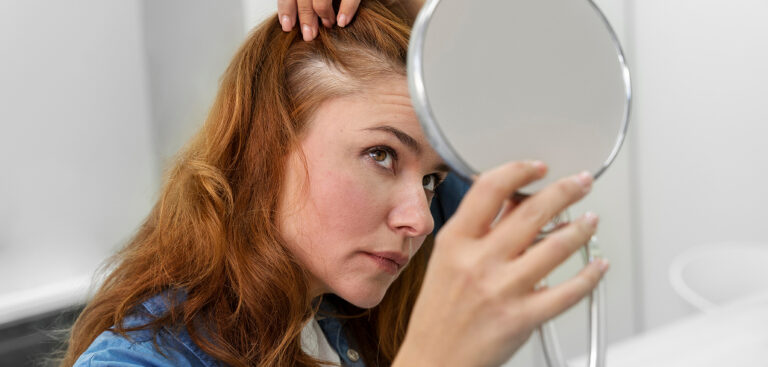
Hair loss and hair thinning are among the most distressing symptoms women experience in their 40s and 50s. For many, it feels sudden, personal, and deeply unsettling — not because it’s cosmetic, but because it often signals deeper physiologic shifts.

In clinical practice, the pattern is strikingly consistent. Many women do exactly what they’re supposed to do: they check labs. Sometimes thyroid dysfunction is identified and treated, and while energy, mood, or sleep may improve, the hair loss often persists.

What follows is a familiar sequence: fluctuating cycles, joint aches, brain fog, hot flashes, fatigue, and accelerating hair thinning. By the time many women reach their early-to-mid 40s, perimenopause has quietly arrived — and while lifestyle changes or hormone therapy may help some symptoms, hair loss often lingers.

This is not uncommon. Up to 50% of women experience noticeable hair loss during the menopausal transition.

This overlap of symptoms — hormonal, metabolic, inflammatory — is one of the reasons we built Thrive, our women’s health program designed specifically for the perimenopausal and menopausal transition. Hair loss is rarely an isolated issue, and treating it effectively requires understanding the full physiologic context.


1. Why Hair Loss Happens During Hormonal Transitions

Hair follicles are not passive structures. They contain receptors for estrogen, progesterone, testosterone, and other androgens. As hormone levels fluctuate — particularly estrogen — these receptors respond.

While research is still evolving, evidence suggests estrogen may:

  • Prolong the anagen (growth) phase of the hair cycle
  • Help maintain hair shaft diameter
  • Support follicular health

As estrogen levels decline or fluctuate unpredictably, hair growth may slow, hair shafts may thin, and shedding may increase.


pexels-mart-production-7699410

2. Why Some Women Lose Hair? (and Others Don’t)

Not all women experience hair loss during menopause. Hormones are only part of the story. Other contributors include:

Women with early menopause, PCOS, androgen dominance, thyroid disease, or insulin resistance are at higher risk.


3. Hormones Beyond Estrogen

I. Androgens (Testosterone & DHT)

Excess androgen activity — particularly DHT — can shrink hair follicles and shorten the growth cycle, leading to finer, weaker hairs. Androgen dominance becomes more common during perimenopause as estrogen declines.

II. Progesterone

Progesterone helps counterbalance androgens. Low progesterone can allow androgen effects to dominate, accelerating hair thinning.

III. Thyroid Hormones

Both hypothyroidism and hyperthyroidism disrupt hair cycling. Thyroid dysfunction is a major and frequently overlooked contributor to female hair loss.


4. Nutrients That Matter for Hair Growth

Hair is a metabolically expensive tissue. Deficiencies commonly linked to hair loss include:

  • Iron (ferritin)
  • Vitamin D
  • B-complex vitamins (B2, B3, B5, B7, B12)
  • Zinc
  • Copper
  • Selenium
  • Omega-3 fatty acids
  • Vitamin C, A, E, and K

Micronutrient testing is often far more informative than guessing.


6. Types of Hair Loss Seen in Women

  • Female Pattern Hair Loss (FPHL) – thinning at the crown and sides
  • Telogen Effluvium – stress-related shedding
  • Anagen Effluvium – medication-related loss (e.g., chemotherapy)
pexels-thefullonmonet-28994562

7. Evaluation: What a Proper Workup Looks Like

This structured, systems-based evaluation is the framework we use clinically — and the same approach that underpins Thrive.


8. Treatment Options (Often Combined)

I. Hormone Replacement Therapy (HRT)

HRT may stabilize follicles by restoring estrogen and progesterone balance. Not appropriate for everyone, but worth evaluating.

II. Nutritional Repletion

Correcting deficiencies is foundational.

III. Medical Therapies
  • Topical or oral minoxidil
  • Spironolactone
  • Finasteride (select cases)
IV. Advanced Therapies
  • Platelet-Rich Plasma (PRP)
  • Microneedling with regenerative products
  • Autologous stem cell–based approaches
V. Lifestyle & Stress Management

Stress-driven telogen effluvium is real and powerful.


9. Final Thoughts

Hair loss during perimenopause and menopause is complex — but it is not something women must simply accept.

In my experience, outcomes improve significantly when hair loss is approached as part of a broader midlife health transition, rather than treated as an isolated cosmetic concern.

If you’re experiencing hair loss alongside other hormonal or metabolic changes and want a comprehensive, data-driven evaluation, Thrive was built for exactly this stage of life. You can learn more or schedule an appointment here:

Thrive: A Women’s Health & Hormone Program

  • Comprehensive lab testing
  • Personalized care and treatment plan
  • Access to online education
  • Pay as you go, no annual fees
Hair-Restoration-fullwidth-n-m

Frequently Asked Questions


Patient Outcomes: Renewed Mobility, Vitality, and Longevity


These patient success stories reflect our commitment to treating the root biological causes of knee pain, rather than just masking symptoms. Our mission is to help you restore function, stay active, and age stronger — so you can move better and live better every day.

Book a consultation to explore your personalized path to living, moving, and performing better, longer.

Take the First Step Towards a Better You

Connect with us today to start your journey to living, looking, and performing better, longer.