By Khoshal Latifzai • March 26, 2026

Strength Training, Testosterone, and the Performance Equation: What Every Patient Needs to Know

BOOK AN APPOINTMENT

There is a version of fitness that most people settle for: showing up, going through the motions, doing enough to feel like they did something. And then there is the version that actually changes your body, your hormones, your metabolism, and your trajectory as you age.

The difference between those two versions is not talent or genetics. It is understanding the biology behind what you are doing, and being willing to challenge yourself in a way that produces a real physiological response.

In my work as a performance and optimization specialist, I spend a significant amount of time helping patients understand the relationship between strength training, hormone health, nutrition, and long-term performance. These systems are deeply interconnected. What you do in the gym affects your testosterone. Your testosterone affects your muscle mass and insulin sensitivity. Your insulin sensitivity affects your metabolic health and your longevity. And all of it is influenced by how well you sleep, how you manage stress, and what you put in your body.

Let me walk you through the key principles I think every patient should understand.


1. Why Strength Training Is Non-Negotiable

Resistance training is not just for athletes or bodybuilders. It is one of the most powerful longevity interventions available to any human being, regardless of age or starting point.

The benefits go well beyond aesthetics. Building and preserving muscle mass is directly associated with better insulin sensitivity, lower risk of metabolic disease, improved bone density, reduced risk of injury, and better cognitive function as you age. Muscle is metabolically active tissue. The more of it you carry, the more efficiently your body handles glucose, the more resilient your metabolism becomes, and the more physical capability you maintain as the decades pass.

One of the principles I emphasize most in my practice is this: the goal of strength training is not just to be strong now. It is to be strong enough, mobile enough, and capable enough decades from now. The muscle you build and the movement patterns you develop today are investments in the person you will be at 60, 70, and beyond.

The most important rule, especially as you age: don’t get hurt. Injury is the enemy of consistency, and consistency is the variable that determines long-term outcomes. Proper warm-up, progressive overload, attention to form, and respect for recovery are not optional extras. They are the foundation.

That said, the equally important counterpart to avoiding injury is challenging yourself. Progress requires stress. The body adapts to demands placed on it. If you are not pushing your limits, in a controlled and intelligent way, you are not getting the full return on your investment of time and effort. Both principles matter, and the balance between them is where good coaching and good clinical guidance become invaluable.


2. The Mechanics of an Effective Warm-Up

One of the most underappreciated aspects of training is what happens before the first working set. A proper warm-up is not five minutes on a treadmill. It is the process of activating the specific muscles and movement patterns you are about to load.

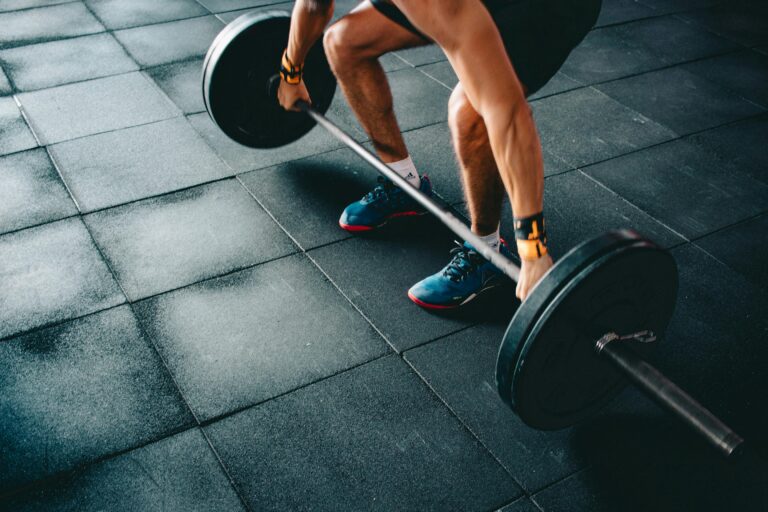
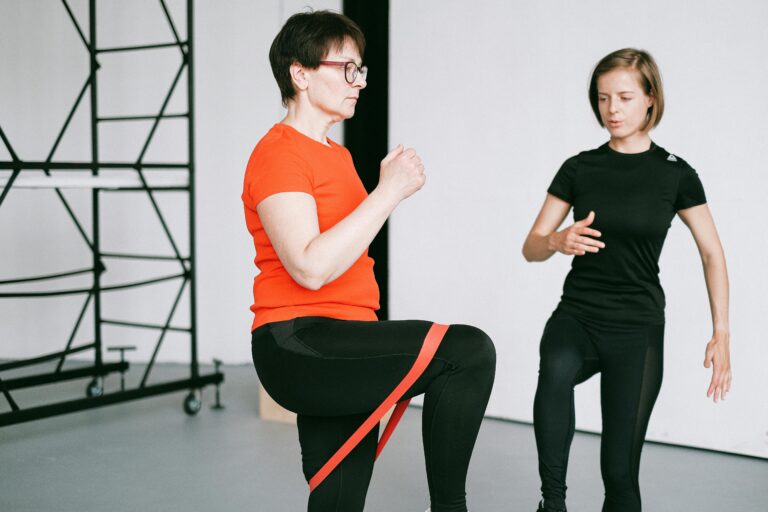
  • For lower body training, this means getting the glutes and hip stabilizers firing before you squat or deadlift. Walking forward and backward, lateral movement, hip hinging, and targeted glute activation work are all part of preparing the body to move safely under load. The glute medius and TFL in particular are muscles that disengage quickly from sedentary modern lifestyles and need to be deliberately activated before heavy lower-body work.
  • For upper body training, the shoulder and elbow joints need to be warmed through their full range of motion before loading. Mobility work, band exercises, and progressive loading with lighter weights before working sets all contribute to joint preparation and injury prevention.

This is especially important for people who spend most of their day sitting. Sitting shortens hip flexors, inhibits glutes, and creates the postural imbalances that lead to injury when untrained people load a squat pattern. Getting these muscles awake before training is not optional. It is the difference between productive training and a path to injury.

pexels-shvetsa-4587427

3. Sitting: The Hidden Performance Killer

Speaking of sitting, I want to address something that is underappreciated in most conversations about health and fitness.

We are born with the ability to squat, hip hinge, and move in full ranges of motion. Watch any toddler and you will see a perfect squat pattern. But sustained sitting, year after year, gradually dismantles those movement patterns. Hip flexors tighten. Glutes inhibit. The posterior chain weakens. Thoracic mobility decreases.

By the time most adults try to lift weights, they are working against years of accumulated postural dysfunction. This is one of the strongest arguments for teaching strength movement patterns to children early, before sitting has had the chance to do its damage. It is also an argument for standing desks, movement breaks, and any intervention that reduces the cumulative hours spent in flexion.

For my adult patients, this means that mobility and movement quality are prerequisites for loading. You have to earn the right to put weight on a movement pattern that your body hasn’t performed in years.


4. Nutrition and Performance: The Diet Connection

What you eat is inseparable from how you perform, how you recover, and how your body composition changes over time. This is not a complicated idea, but it is one that takes most people years of experience to truly internalize.

Protein is the most critical macronutrient for anyone engaged in strength training. Muscle protein synthesis, the process by which your body builds new muscle tissue, requires adequate amino acid availability. The research consistently points to approximately 1.6 to 2.0 grams of protein per kilogram of body weight as the range needed to support muscle growth and preservation. For a 180-pound person, that is roughly 130 to 160 grams of protein per day.

Timing matters too. Distributing protein intake across multiple meals throughout the day maintains higher, more consistent amino acid availability for muscle protein synthesis than concentrating the same amount in one or two meals.

For many of my patients, particularly those struggling with body composition, the ketogenic diet has been a valuable tool. Not as a permanent prescription for everyone, but as an intervention that can significantly reduce hunger, control cravings, improve metabolic flexibility, and support fat loss without sacrificing muscle or strength. The evidence from clinical practice is consistent: many people who have struggled to lose fat on conventional diets find that reducing carbohydrates dramatically changes the equation.

The key principle is that dietary strategy should be individualized. There is no single diet that is optimal for every person at every stage of their life. Understanding your metabolic response, your training demands, your hormonal environment, and your personal history with food is what allows us to build a nutrition strategy that actually works for you. This is exactly what our team does through our annual membership and personalized performance programs. Learn more about our approach.

pexels-alexy-almond-3758005

5. Testosterone: What It Does and What Drives It Down

Testosterone is not just a performance hormone. It is a metabolic hormone with profound effects on insulin sensitivity, muscle mass preservation, body fat distribution, energy, mood, libido, and long-term health.

Low testosterone is increasingly common, and the drivers are largely lifestyle-based. The three I see most frequently in clinical practice are sleep deprivation, chronic stress and elevated cortisol, and metabolic dysfunction.

At RMRM, our approach to testosterone is comprehensive and individualized. We assess free testosterone, sex hormone-binding globulin, estradiol, DHT, DHEA, FSH, LH, and other relevant markers to understand the specific mechanisms driving any imbalance. There are often multiple levers we can act on before considering exogenous hormone therapy. Learn more about our hormone therapy options and our diagnostics and therapies.


6. The Power of Discipline and Consistency

One thing that decades of performance medicine reinforces is that the difference between people who achieve extraordinary results and those who don’t is rarely talent. It is discipline and consistency applied over long enough periods of time.

The most elite performers in any physical domain share a common trait: they show up, they follow their protocols, and they do it day after day regardless of how they feel. This is not about obsession or perfectionism. It is about understanding that results are the product of compounded effort over time, and that inconsistency is the single greatest saboteur of progress.

The good news is that you don’t need to train like an elite athlete to get transformative results. The principle scales down beautifully. A 10-minute walk every day is better than nothing, and for many people, it is the starting point that eventually becomes something much more. Progress builds on itself. The key is starting, and then not stopping.

7. Search Real Solutions

At RMRM, we meet patients wherever they are on that spectrum and build from there. Whether you are just beginning to take your fitness seriously or you are an experienced athlete looking to optimize every variable, the work is always the same: understand your biology, build a protocol grounded in that understanding, and execute with consistency.

Book an appointment with our team in Boulder to start building your performance and longevity strategy. Explore our therapies, diagnostics, and annual membership to see how we support you over the long term.


BOOK CONSULTATION

Tailored Care
for a Life Well Lived

Personalized treatment plans to help you live longer, look better, and perform at your best—no matter your age.

Step 1 – Understanding You

We start by listening carefully to your health concerns, objectives, and goals. Through a personalized consultation, we gather critical information, including relevant biomarkers, to establish a clear baseline for your individual health needs.

Step 2 – Personalized Plan Implementation

Using detailed insights gained from your assessment, we design and initiate a tailored health plan. This data-driven approach ensures interventions are specific to your body, lifestyle, and wellness goals, setting you on a clear path toward optimal health.

Step 3 – Reassessment and Refinement

Your progress is regularly measured against key health indicators and biomarkers, enabling us to objectively evaluate your improvement. Based on these insights, we continually refine your treatment plan to keep you moving toward your desired outcomes and long-term wellness.

GET STARTED

Frequently Asked Questions By Patients


Patient Success Stories

These patient success stories reflect our commitment to treating the root biological causes of knee pain, rather than just masking symptoms. Our mission is to help you restore function, stay active, and age stronger, so you can move better and live better every day.

Book a consultation to explore your personalized path to living, moving, and performing better, longer.

Take the First Step Towards a Better You

Connect with us today to start your journey to living, looking, and performing better, longer.