
What Are Peptides and Why Do They Matter After 40?
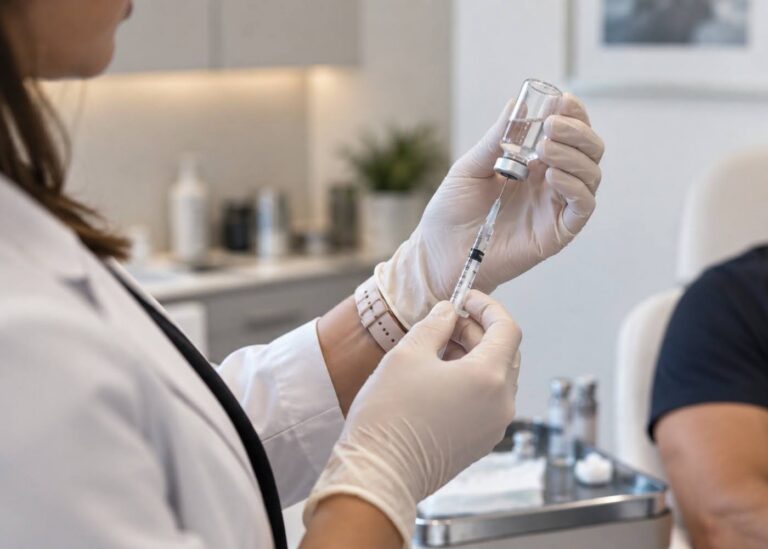
Peptides are everywhere in your body. Insulin, oxytocin, and the hormones that trigger growth hormone release are all peptides. After 40, production of many key peptides starts to slow down, and that decline plays a direct role in how you feel day to day. What makes peptide therapy different from many conventional approaches is that peptides work with the body’s natural signaling systems rather than overriding them, which is why they tend to be well tolerated and remarkably specific in their actions.
How does the body change after 40?
Growth hormone output, which supports tissue repair, fat metabolism, and deep sleep, can drop by 50% or more by age 40. NAD+ levels also decline with age, which may reduce cellular energy production and DNA repair capacity.
Here is a quick snapshot of what tends to change:
- Recovery slows down. Tendons, muscles, and joints take longer to bounce back from exercise or minor injury.
- Sleep quality shifts. Deep sleep, the stage where growth hormone release peaks, often fragments after 40.
- Body composition changes. Lean muscle becomes harder to maintain, and visceral fat tends to accumulate even without dietary changes.
The good news is that these shifts are measurable. Whether you are in Boulder, CO, or anywhere else in the country, baseline biomarker testing can reveal where your IGF-1 and metabolic indicators stand before any protocol begins.
Peptide therapy for recovery after 40 aims to support the body by restoring some of these fading signals, rather than replacing hormones directly.
How Peptide Therapy Works in Practice
Peptide protocols are not one-size-fits-all, and the difference between a good outcome and a wasted effort often comes down to how the protocol is set up. A responsible plan generally includes:
- Comprehensive lab work first. Baseline blood panels covering growth hormone markers, IGF-1, metabolic markers, and inflammatory markers should be reviewed before any peptide is prescribed.
- Medical supervision throughout. A licensed provider should adjust dosing based on lab results and individual response.
- Cycling. Most growth hormone peptides benefit from cycling, such as 8 to 12 weeks on followed by 4 to 8 weeks off, to maintain receptor sensitivity.
Why does hormone health matter alongside peptides?
Even the best peptide protocol can underperform if the hormonal picture is out of balance. Hormone health, particularly testosterone and thyroid function, plays a major role in how the body responds to peptide therapy, and addressing both together may produce better outcomes than either approach alone.
What Should You Consider Before Starting?
Are peptides safe?
When used under medical supervision and at appropriate doses, the peptides discussed here are generally well tolerated. Common side effects tend to be mild, such as injection-site irritation, temporary water retention, or occasional headaches. Long-term human safety data remains limited for many of these compounds, and unregulated products purchased online carry the greatest risk.
Who should avoid peptide therapy?
People with active cancer diagnoses, unmanaged diabetes, or those who have not yet built foundational health habits like consistent sleep, nutrition, and exercise may need to wait before pursuing peptides.
Conclusion
Getting older does not have to mean feeling worse every year. Aging after 40 brings real biological shifts, and peptide therapy offers one avenue for supporting the body through those changes by working with your biology rather than against it.
At Rocky Mountain Regenerative Medicine in Boulder, CO, every peptide protocol follows a three-step process:
- Understand: Comprehensive biomarker testing maps where your organ function, immune response, endocrine system, IGF-1, and metabolic indicators stand today.
- Personalized Plan: Your provider builds a peptide therapy protocol matched to your lab results and goals.
- Reassess and Refine: Follow-up testing tracks how your body responds, so dosing and timing can be adjusted over time.
Peptide therapy also works best when paired with complementary longevity services. Hyperbaric oxygen therapy may enhance cellular oxygenation and recovery, IV therapy can deliver key nutrients directly, and hormone optimization addresses the hormonal shifts that amplify age-related decline. For ongoing, integrated care, the Annual Membership Program brings all of these pieces together under one plan.
Note: The information in this article is for educational purposes only and is not intended as medical advice. Peptide therapy should only be undertaken under the supervision of a licensed medical provider. Individual results vary. Always consult with a qualified healthcare professional before beginning any new therapeutic protocol.
Sources
- Fernández-Garza LE, et al. Therapeutic peptides in gerontological medicine. Frontiers in Aging. 2026. https://www.frontiersin.org/journals/aging/articles/10.3389/fragi.2026.1790247/full
- Junnila RK, et al. Growth hormone and aging. NCBI Bookshelf (Endotext). Updated 2026. https://www.ncbi.nlm.nih.gov/books/NBK279163/
- Covarrubias AJ, et al. NAD+ metabolism and its roles in cellular processes during ageing. Nature Reviews Molecular Cell Biology. 2021. https://pubmed.ncbi.nlm.nih.gov/33353981/
- Sikiric P, et al. Stable gastric pentadecapeptide BPC 157 and wound healing. Frontiers in Pharmacology. 2018. https://pubmed.ncbi.nlm.nih.gov/30915550/
- From Regeneration to Analgesia: The Role of BPC-157 in Tissue Repair and Pain Management. International Journal of Molecular Sciences. 2026. https://pubmed.ncbi.nlm.nih.gov/41898733/
- Emerging Use of BPC-157 in Orthopaedic Sports Medicine: A Systematic Review. PubMed. 2025. https://pubmed.ncbi.nlm.nih.gov/40756949/
- Khorram O, et al. Endocrine and metabolic effects of long-term GHRH administration in age-advanced men and women. Journal of Clinical Endocrinology and Metabolism. 1997. https://pubmed.ncbi.nlm.nih.gov/9141536/
- Pickart L, Margolina A. Regenerative and protective actions of the GHK-Cu peptide. International Journal of Molecular Sciences. 2018. https://pmc.ncbi.nlm.nih.gov/articles/PMC6073405/
- NAD+ precursor supplementation in human ageing: clinical evidence and challenges. PubMed. 2025. https://pubmed.ncbi.nlm.nih.gov/41083806/