By Andrea Carolina • December 3, 2025

Lp(a): The Overlooked Cholesterol Particle That 1 in 5 People Inherit

BOOK AN APPOINTMENT

Lp(a): The Overlooked Cholesterol Particle That 1 in 5 People Inherit

Most people know their “bad cholesterol,” their “good cholesterol,” and maybe their triglycerides. But very few people have ever been tested for one of the most genetically powerful drivers of heart disease and aortic valve disease: Lp(a) — also called “L-P-little-a.”

About 20% of the population inherits elevated Lp(a), and most never know it.

To make sense of this particle, let’s use a simple analogy.


1. Lp(a) is like LDL wearing a Velcro jacket

Imagine LDL cholesterol as a smooth tennis ball. Now imagine another version of that ball wrapped in a Velcro jacket.

That Velcro jacket is a special protein called apo(a). When LDL puts on this jacket, it becomes stickier and more inflammatory. It attaches more easily to damaged artery walls and carries pro-inflammatory debris that irritates the vessel lining.

This makes Lp(a) much more dangerous than regular LDL.

Image
2. Why some people produce more Lp(a)?

The Velcro jacket (apo(a)) comes in different sizes. Some people inherit a very small jacket, and the liver produces a lot of these particles. Others inherit a larger jacket and produce fewer.

The key point is this:

  • Lp(a) levels are almost entirely genetic.
  • Lifestyle does not meaningfully change it.
  • Diet does not lower it.
  • Exercise does not lower it.

This is why many people with excellent cholesterol panels still develop premature heart disease — the hidden Lp(a) risk.


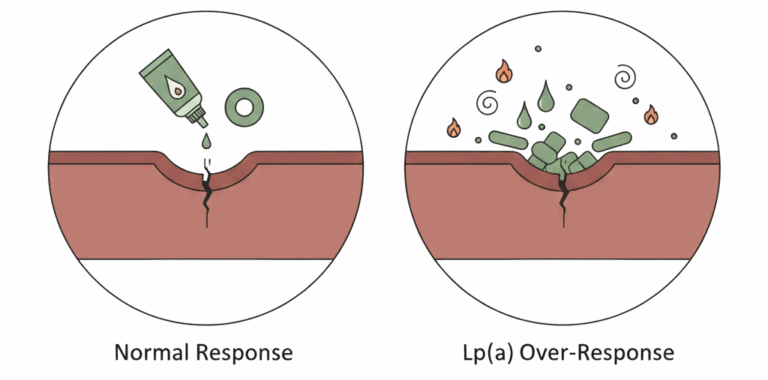
3. Why Lp(a) is risky: the “cleanup crew that won’t go home”

Think of Lp(a) as an emergency repair crew designed to patch up injuries. In ancient times, this was helpful for survival. But in today’s world — where chronic inflammation replaces acute injury — the crew keeps showing up unnecessarily.

Every time there’s a small irritation in the artery:

  • Lp(a) sticks to the area
  • It drops off the inflammatory material
  • It makes the blood slightly more prone to clot
  • It creates debris that stays in the vessel wall
  • Over time, plaque grows faster

This is why elevated Lp(a) is associated with:

  • Heart attacks
  • Strokes
  • Aortic valve calcification
  • Early cardiovascular disease
Untitled design (1)

4. Why Lp(a) Damages the Aortic Valve

The aortic valve is like a door hinge that opens and closes millions of times a year. If you keep throwing sand, glue, and small debris at that hinge, it stiffens and calcifies.

That is exactly how Lp(a) affects the valve.

This connection is so strong that Lp(a) is now considered one of the most important risk factors for aortic stenosis, especially as people age.

Untitled design
5. What can you do if your Lp(a) is high?

Here’s the most important thing to know:

Lowering the Lp(a) number itself is extremely difficult with current treatments. But lowering your risk is absolutely possible.

You can dramatically reduce overall cardiovascular risk by focusing on:

  • Lowering ApoB (total number of cholesterol particles)
  • Lowering inflammation
  • Improving metabolic health
  • Reducing triglycerides
  • Evaluating the aortic valve periodically
  • Considering medications that indirectly reduce Lp(a)
  • Considering future therapies specifically designed to target Lp(a)
6. Medications that reduce Lp(a)
  • PCSK9 inhibitors: reduce Lp(a) by ~20–30%
  • Niacin: reduces Lp(a) by ~20–30% (but limited by side effects and no demonstrated outcome benefit)
  • Apheresis: reduces Lp(a) by 60–75% (used for severe, refractory cases)
  • Antisense therapies (coming soon): can reduce Lp(a) by up to 80–90%
Young doctor is using a stethoscope listen to the heartbeat of the patient. Shot of a female doctor giving a male patient a check up

7. The bottom line

Lp(a) is one of the most important — and most overlooked — cardiovascular risk markers.

If your Lp(a) is elevated, you can still dramatically reduce your risk by lowering ApoB, improving metabolic health, and addressing inflammation.


Frequently Asked Questions


Patient Outcomes: Renewed Mobility, Vitality, and Longevity

These patient success stories reflect our commitment to treating the root biological causes of knee pain, rather than just masking symptoms. Our mission is to help you restore function, stay active, and age stronger — so you can move better and live better every day.

Book a consultation to explore your personalized path to living, moving, and performing better, longer.

Take the First Step Towards a Better You

Connect with us today to start your journey to living, looking, and performing better, longer.