
You’ve been dealing with chronic pain from a tendon injury for months, or maybe years. Physical therapy helped a little. Rest helped a little. But you’re still limited, still uncomfortable, and ready for something that actually works.
Shockwave therapy might be what you’re looking for.
This treatment uses focused acoustic waves, not surgery or injections, to trigger your body’s natural healing process. It’s noninvasive, takes only a few minutes per session, and doesn’t require downtime. Here’s how it works and why it’s become a go-to option for soft tissue injuries that don’t respond to standard treatment.
What Is Shockwave Therapy?
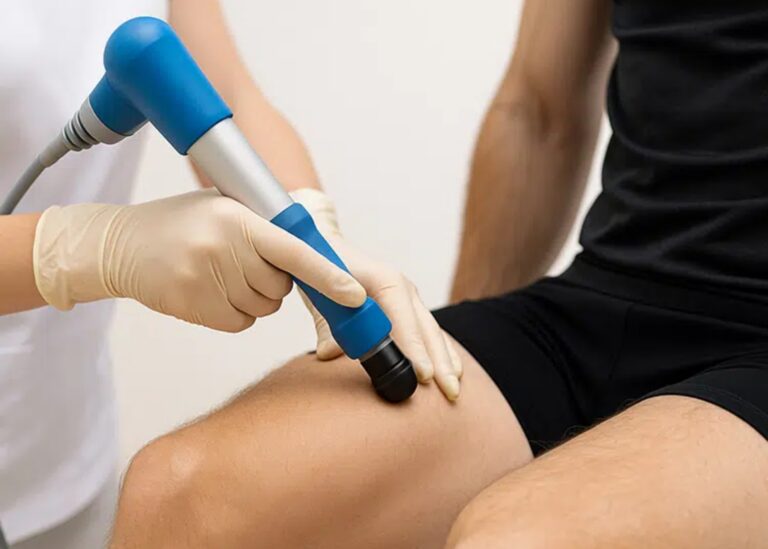
Shockwave therapy, medically known as extracorporeal shockwave therapy or ESWT, uses high-energy sound waves to repair damaged soft tissue. A therapist applies a handheld device directly to your skin, which delivers rapid pulses of acoustic energy into the injured area.
Those pressure waves don’t just reach the surface. Depending on the type of device, they penetrate 6 centimetres or more into your body, reaching deep muscle, tendon, and bone tissue that massage and other surface treatments simply cannot.
The waves themselves are mechanical energy. Think of them as a focused, controlled vibration that travels through tissue and triggers a biological response at the cellular level.
How the Healing Process Works
Shockwave therapy doesn’t heal tissue by brute force. Instead, it works by activating your body’s own repair mechanisms.
Wave energy triggers a cellular response: When acoustic waves reach damaged tissue, they create mechanical stress at the cell level. That stress activates cellular machinery called mechanotransduction, which tells cells that repair is needed.
Growth factors get released: Once the cells sense stress, they release growth factors and signaling molecules. These compounds recruit more cells to the injury site and instruct them to begin forming new collagen, blood vessels, and functional tissue.
Blood flow increases: The waves also stimulate angiogenesis, the formation of new blood vessels. More blood means more oxygen and nutrients delivered to the injured area, speeding up the healing cascade.
Inflammation is modulated: The therapy can help reduce chronic inflammatory responses that keep tissue stuck in a damaged state, particularly in conditions like tendinitis and plantar fasciitis.
The result is tissue that doesn’t just scar over, but actually regenerates.
What Conditions Can Shockwave Therapy Treat?
Shockwave therapy has the strongest evidence for chronic soft tissue conditions that have resisted other treatments. ESWT can be used for several musculoskeletal problems, particularly those that haven’t responded to rest, physical therapy, or injections.
Common conditions treated with shockwave therapy include:
- Chronic tendon injuries: Tennis elbow, golfer’s elbow, rotator cuff tendinitis, and Achilles tendinitis often respond well to ESWT when conservative treatment hasn’t resolved them. These conditions involve collagen degeneration in the tendon, and acoustic waves stimulate the healing response needed to rebuild that tissue.
- Plantar fasciitis and heel pain: Heel pain due to plantar fascia damage is among the most studied applications. Shockwave can break down the calcifications that form in chronic cases and restart the healing process, often providing relief when months of stretching and orthotics have failed.
- Bursitis and inflammation: Inflamed bursa sacs, particularly in the shoulder and hip, may improve with acoustic wave treatment. The therapy’s ability to reduce chronic inflammation makes it useful for conditions in which the body has become stuck in a prolonged inflammatory state.
- Myofascial pain syndromes: Chronic muscle and fascia pain can respond to radial shockwave therapy, especially when combined with physical therapy and exercise. This is a newer application, but it is showing promise in clinical trials.
- Bone-healing complications: Some evidence suggests that ESWT may help with non-union fractures and certain types of bone damage where the body hasn’t initiated proper healing on its own.
Shockwave is FDA-cleared and has demonstrated a strong safety profile across all these applications. Success rates vary depending on how long the condition has existed, the patient’s age and overall health, and whether other treatments have been tried first.
The Two Main Types of Shockwave Therapy
Not all shockwave devices work the same way. There are two primary types, and understanding the difference matters.
Focused shockwave therapy (FSWT): This generates pressure waves that converge at a specific depth within the tissue. The waves are most intense at that focal point, making focused therapy ideal for smaller, deeper targets, such as a calcified tendon insertion. It requires imaging guidance for precise targeting.
Radial shockwave therapy (RSWT): This produces pressure waves that radiate outward from the applicator head. Energy is highest at the surface and decreases with depth. Radial therapy covers a larger treatment area and doesn’t require imaging guidance, making it useful for a broader range of soft-tissue conditions and myofascial pain.
Many clinics use both types during a single treatment session, targeting different structures and penetration depths.
What to Expect During Treatment
A shockwave session is straightforward and takes about 10 to 30 minutes, depending on the size of the area being treated.
Before treatment, your provider will examine the injury, possibly with an ultrasound or X-ray, to confirm the diagnosis and plan the approach. Wear comfortable clothes that allow easy access to the treatment area.
During treatment, you’ll lie or sit in a comfortable position. Your provider applies a water-based gel to your skin, which helps the acoustic waves pass through without loss of energy. The handheld applicator is then pressed against your skin, and the device delivers pulses. You may feel a tapping or thumping sensation, sometimes uncomfortable but rarely painful. Intensity can be adjusted if needed.
After treatment, you can return to normal activities immediately. Some mild soreness or temporary bruising may occur, but there is no downtime and no recovery period required.
Treatment Frequency and Timeline
Shockwave therapy isn’t a one-time fix. Most conditions require multiple sessions spaced one to two weeks apart.
A typical course involves 3 to 6 sessions, though some people need more depending on the severity and duration of the injury. Your provider will determine the right number based on your condition.
Many patients notice improvement after 2 to 4 sessions, but the full healing response can take 8 to 12 weeks to develop fully. The waves trigger the healing cascade, but actual tissue remodeling takes time.
Benefits and Why Patients Choose Shockwave
The appeal of shockwave therapy comes down to what it offers that other treatments don’t. Patients and providers choose ESWT for several compelling reasons that distinguish it from conventional treatment approaches.
Key advantages of shockwave therapy include:
- Noninvasive with minimal recovery: No incisions, needles, or surgery are involved. The acoustic waves do all the therapeutic work from outside your body. You can return to normal activities immediately after treatment, taking only 15 to 30 minutes per session with zero downtime required.
- Addresses root causes, not just symptoms: Unlike anti-inflammatory medication or steroid injections that only temporarily manage pain, shockwave therapy stimulates tissue repair and regeneration at the cellular level. This approach targets the underlying damage rather than masking discomfort, potentially leading to longer-lasting improvement.
- Avoids repeated injections and their side effects: For conditions that might otherwise require yearly or recurring steroid shots, shockwave offers a chance at lasting improvement without the tissue damage that long-term steroid overuse can cause. This is particularly important since repeated injections have been shown to weaken tissue over time.
- Excellent safety profile: The most common side effect is mild soreness or temporary skin redness. Severe complications are extremely rare when performed by trained providers. ESWT has been studied extensively since the 1980s, with thousands of published studies demonstrating its safety and effectiveness for specific conditions.
Beyond these practical advantages, many patients appreciate that shockwave therapy represents a regenerative approach to healing. Rather than replacing damaged tissue with scar tissue or managing inflammation pharmacologically, ESWT encourages your body to rebuild itself.
Limitations and What Shockwave Cannot Do
Shockwave works best for chronic soft tissue injuries that have already been diagnosed and have failed conservative treatment.
It may not work well for:
Acute injuries. If you injured yourself last week, rest and physical therapy may be more appropriate. Shockwave is typically reserved for chronic conditions.
Severe or complete tears. If a tendon or ligament is fully ruptured, you likely need surgical repair before considering shockwave.
Certain medical conditions. Shockwave is not used if you’re pregnant, have an active infection at the treatment site, have a bone tumor, or take blood thinners at therapeutic levels.
Very early-stage conditions. If conservative treatment hasn’t been tried or you haven’t given it adequate time, shockwave may not be the first step.
Realistic expectations matter. Shockwave therapy can improve pain and function significantly, but results vary. Some people see dramatic improvement. Others see modest improvement. A minority sees little benefit.
How Shockwave Compares to Other Treatments
Versus physical therapy alone: Physical therapy is often the first-line treatment and remains important even after shockwave therapy. Combining both typically works better than either alone.
Versus steroid injections: Injections provide quick anti-inflammatory relief but don’t address the underlying tissue damage, and repeated use can weaken tissue. Shockwave works more slowly but triggers actual repair.
Versus surgery: Shockwave is far less invasive, has no recovery time, and no surgical risks. For many chronic tendon and soft tissue conditions, it can be a first alternative before considering surgery.
Versus ultrasound or massage: These are gentler treatments but have less penetrating power and less evidence supporting their ability to trigger deep tissue regeneration.
The Role of Diagnostics in Shockwave Success
Getting the right diagnosis before starting shockwave therapy matters. Your provider should confirm the injury with imaging (ultrasound, X-ray, or MRI), understand the exact location and extent of damage, and rule out conditions that shockwave cannot treat.
That’s why a comprehensive evaluation, including advanced diagnostics, is the foundation of effective shockwave treatment. You want to know exactly what you’re treating before acoustic waves start the repair process.
Conclusion
Shockwave therapy offers a real alternative for chronic soft tissue injuries that haven’t responded to conventional treatment. By triggering your body’s own healing mechanisms rather than just masking pain, it addresses the root problem.
The treatment is noninvasive, requires minimal downtime, and has strong research support across dozens of conditions. If you’ve been dealing with chronic tendon pain, plantar fasciitis, or other soft tissue injuries, shockwave may be worth exploring.
Ready to explore acoustic wave therapy for your injury? At Rocky Mountain Regenerative Medicine in Boulder, we combine shockwave therapy with advanced diagnostics and personalized care planning to give you the best chance at lasting improvement. Our providers assess your specific injury and develop a treatment plan customized to your condition and goals.
Contact us to schedule a consultation and learn whether shockwave therapy is right for you.