
Knee pain is one of the most common reasons Americans visit an orthopedic specialist, and for many, the conversation quickly turns to surgery. However, a growing number of patients in Boulder, Colorado, are exploring a different path. For mild to moderate joint damage, regenerative medicine knee treatment could offer meaningful relief without the risks, downtime, and uncertainty that come with going under the knife.
At Rocky Mountain Regenerative Medicine, the approach to knee osteoarthritis goes beyond any single treatment. A combination of adipose-derived stem cell therapy, PRP, peptide therapy, shockwave therapy, and hyperbaric oxygen therapy works together to address joint degeneration from multiple angles, creating conditions for actual healing rather than just symptom management.
Key Takeaways
- Knee osteoarthritis affects millions of Americans, and knee replacement rates continue to rise.
- Regenerative treatments like PRP and stem cell therapy aim to support the body’s own repair processes rather than removing or replacing tissue.
- Candidates for a knee surgery alternative typically have mild to moderate joint damage.
- Regenerative medicine does not work for everyone, and a proper evaluation is the first step.
Why So Many Americans Face Knee Surgery
Millions of Americans face knee surgery each year because osteoarthritis and joint injuries gradually destroy cartilage. Osteoarthritis alone affects roughly 32.5 million adults in the United States (CDC), and the knee accounts for the majority of osteoarthritis-related disability (PNAS, 2017). CDC data shows that from 2000 through 2010 alone, an estimated 5.2 million total knee replacements were performed, with rates continuing to climb (CDC/NCHS, 2015).
What causes knee pain to get worse over time?
Knee pain rarely shows up out of nowhere. Wear and tear builds gradually over years, and several factors may speed up the process:
- Age. Cartilage naturally loses its ability to cushion the joint as we get older. Annual incidence of knee osteoarthritis peaks between ages 55 and 64 (PubMed, 2013).
- Body weight. Extra weight puts added pressure on the knee with every step, which may accelerate cartilage breakdown.
- Past injuries. An old sports injury or torn meniscus can change how the knee absorbs force, creating uneven wear over time.
- Repetitive stress. Jobs or activities that involve frequent kneeling, squatting, or heavy lifting may contribute to gradual joint damage.
- Inflammation. Chronic, low-grade inflammation in the joint can break down cartilage and weaken surrounding tissues.
When these factors combine, the damage can reach a point where a doctor recommends surgery. For some people, though, there could be a less invasive step worth considering first.
Why do conventional treatments often fall short?
Most people with knee osteoarthritis follow a familiar path before surgery enters the conversation. Anti-inflammatory medications provide temporary pain relief but carry risks with long-term use. Corticosteroid injections reduce pain temporarily, but repeated use may accelerate cartilage breakdown. Hyaluronic acid injections offer mixed results. Physical therapy maintains strength but cannot reverse structural damage. None of these approaches actively promotes healing or regeneration.
What Is Regenerative Medicine Knee Treatment?
Regenerative medicine aims to support the body’s natural ability to heal damaged tissue. Several types of regenerative knee therapy are used in clinical practice, and each works a little differently.
How does PRP therapy work for knee pain?
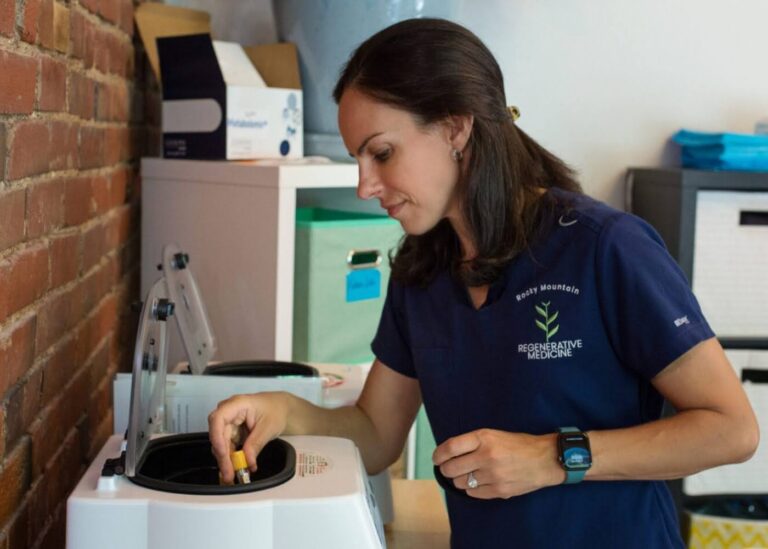
PRP stands for platelet-rich plasma. Platelets are a component of your blood, and the plasma, the liquid portion of PRP, contains concentrated growth factors and proteins involved in tissue repair. During a PRP treatment, 60-120mls of your blood is drawn and spun in a centrifuge to concentrate the platelets, then injected directly into the knee joint.
A meta-analysis published in the American Journal of Sports Medicine found that PRP produced clinically meaningful improvement compared to placebo at all follow-up points in knee osteoarthritis patients (American Journal of Sports Medicine, PMC). A 2025 narrative review noted that leukocyte-poor PRP showed better pain relief and functional improvement compared to hyaluronic acid and corticosteroids in mild to moderate cases (PubMed, 2025).
PRP is a same-day, outpatient procedure with minimal downtime.
How do stem cell injections support knee healing?
Stem cell therapy for knee pain involves injecting mesenchymal stem cells (MSCs) into the damaged joint. Mesenchymal stem cells are cells found in bone marrow and fat tissue that can support the healing of cartilage, bone, and other tissue types. Some clinics use adipose-derived stem cells (from fat tissue) because adipose tissue may provide 500 to 1,000 times more stem cells per gram than bone marrow, with a less invasive harvest procedure and more stable cell numbers as patients age.
A 2022 prospective case series of 329 knee osteoarthritis patients who received adipose-derived stem cell therapy found clinically and statistically significant pain improvement over a two-year follow-up, with no serious adverse events (PubMed, 2022). A 2023 systematic review confirmed that MSC injection was associated with decreased pain and improved function at six and twelve months compared to controls (PMC, 2023).
PRP and stem cell therapy are sometimes combined. PRP may help support the survival of transplanted stem cells, and studies combining the two have shown enhanced results.
Results from stem cell therapy vary from person to person, and a thorough consultation helps set realistic expectations. Patients with mild to moderate joint damage generally report better outcomes than those with advanced, bone-on-bone arthritis.
Can shockwave therapy help with knee pain?
Extracorporeal shockwave therapy (ESWT) is another non-surgical option that uses acoustic waves to stimulate blood flow and promote tissue repair in the affected area. For knee osteoarthritis, shockwave therapy may help break down scar tissue and adhesions that limit movement, improve oxygen and nutrient delivery to the joint, and activate cellular repair mechanisms.
Some practitioners perform shockwave therapy in the days or weeks before a stem cell injection. The goal is to prepare the joint environment so that it may be more receptive to cellular therapy. A treatment session typically lasts 15 to 30 minutes and does not require anesthesia.
How Regenerative Knee Therapy Compares to Surgery
Here is how regenerative approaches compare to surgical options at a glance.
| Feature Regenerative Medicine Knee Surgery | ||
|---|---|---|
| Invasiveness | Minimally invasive (injections) | Surgical (incision, anesthesia) |
| Recovery time | Days to a few weeks | Weeks to months |
| Procedure setting | Outpatient | Hospital or surgical center |
| Goal | Support natural tissue repair | Remove or replace damaged tissue |
| Potential risks | Mild soreness, swelling at the injection site | Infection, blood clots, nerve damage, and implant complications |
| Who it may help | Mild to moderate joint damage | Moderate to severe joint damage |
| Repeat treatments | May need follow-up sessions | Implants may last 15-25+ years; revision is possible over time |
Who May Be a Good Candidate to Avoid Knee Surgery?
Not everyone is a candidate for regenerative knee therapy. A proper evaluation is essential before deciding on any treatment path. In general, people who may benefit from a knee surgery alternative include those who:
- Have mild to moderate osteoarthritis rather than severe, bone-on-bone degeneration
- Experience chronic knee pain that has not improved with physical therapy or medication
- Are you looking for less invasive options before committing to surgery
- Have knee injuries such as partial meniscus tears or ligament strains, mild osteoarthritis, athletes wanting to maintain joint health
People with advanced joint damage or certain medical conditions may still need surgery. However, age alone is not a disqualifier. RMRM has worked with patients well into their 80s, and clinical experience suggests that 70 to 80 percent of appropriately selected patients may experience meaningful improvement.
What to Expect During a Regenerative Medicine Visit
A typical visit for regenerative medicine knee treatment starts with a review of your medical history, imaging (X-rays or MRI), symptoms, and biomarkers. Based on that evaluation, a personalized treatment plan is created.
For PRP, the process takes about 1-2 hours. For adipose-derived stem cell procedures, it takes approximately 3-4 hours for harvest and an hour for injection alone. Fat tissue is harvested through a minor liposuction under local anesthesia, processed to isolate the stem cells, and injected into the knee under ultrasound guidance. Patients go home the same day.
Mild soreness at the injection site and harvest area is common and usually resolves within a few days. Avoiding high-impact activities for four to six weeks allows the joint to heal. Follow-up visits track progress and determine whether supportive therapies like hyperbaric oxygen therapy could be beneficial.
Conclusion
Knee surgery is sometimes the right answer, but for many people with mild to moderate knee pain, regenerative medicine could offer a meaningful knee surgery alternative worth exploring first.
At Rocky Mountain Regenerative Medicine in Boulder, Colorado, the approach goes beyond a single injection. Rather than just deploying stem cells, the team combines cellular therapy with PRP, peptide therapy (such as BPC-157 and TB-500 to support tissue repair), shockwave therapy to prepare the joint, and hyperbaric oxygen therapy to enhance cellular function. Hormone optimization and metabolic support round out a protocol designed to create the best possible environment for healing. Every patient is eligible to receive a customized plan through the Annual Membership Program, with ongoing monitoring and follow-up built in.
Ready to find out if you could avoid knee surgery? Contact RMRM or book an appointment to start the conversation.
Medical Disclaimer: The content in this article is for educational and informational purposes only. Nothing here should be considered medical advice or a substitute for professional medical care. Consult with a qualified healthcare professional before considering any treatment options. Individual results may vary.