
A concussion can feel like a minor injury at first, but for some people, symptoms like brain fog, headaches, and difficulty concentrating can last weeks or months. When standard rest and recovery don’t bring relief, many start looking for options beyond conventional care.
One option getting more attention is hyperbaric oxygen therapy (HBOT). HBOT has established clinical uses for conditions like decompression sickness and chronic wounds, and its potential role in concussion recovery is now being studied.
What You Need to Know
- HBOT involves breathing pure oxygen in a pressurized chamber at 1.5 to 3 times normal atmospheric pressure.
- HBOT for concussion is considered investigational, and no major medical body currently recommends it as standard care.
- Some clinical studies report cognitive improvements after HBOT for post-concussion symptoms, while sham-controlled trials have not found a clear benefit over placebo.
- At RMRM in Boulder, HBOT is offered as part of a personalized, multi-therapy regenerative care plan.
- Side effects are generally mild, and a pre-treatment evaluation helps determine whether HBOT is a good fit.
In This Article
- What Happens During a Concussion
- What Is Hyperbaric Oxygen Therapy
- How HBOT May Support Concussion Recovery
- What the Research Says So Far
- What HBOT Treatment Generally Looks Like
- Who May Consider HBOT After a Concussion
- Possible Side Effects and Safety
- A Note on Insurance
- Taking the Next Step Toward Recovery
- Frequently Asked Questions
What Happens During a Concussion
A concussion is classified as a mild traumatic brain injury (TBI). According to the CDC, TBI is a major cause of death and disability in the United States, with approximately 214,110 TBI-related hospitalizations recorded in 2020 alone [VERIFY: confirm this is the most current CDC figure before publishing]. Most of these injuries are classified as “mild,” which includes concussions.
How concussions affect the brain
A concussion happens when a bump, blow, or jolt to the head disrupts normal brain function. Even though the injury is labeled “mild,” the effects can be significant:
- Reduced blood flow to certain areas
- Temporary changes in how brain cells use energy
- Inflammation around injured tissue
- Disrupted communication between neurons
For most people, symptoms clear up within a few weeks. But an estimated 10-25% may develop post-concussion syndrome (PCS), where symptoms persist well beyond the expected recovery window.
Common post-concussion symptoms
Symptoms vary but often include:
- Persistent headaches or brain fog
- Memory problems and difficulty concentrating
- Dizziness, fatigue, or balance issues
- Sensitivity to light or noise
- Sleep disturbances or mood changes
When symptoms continue for months, people often explore alternative approaches.
What Is Hyperbaric Oxygen Therapy
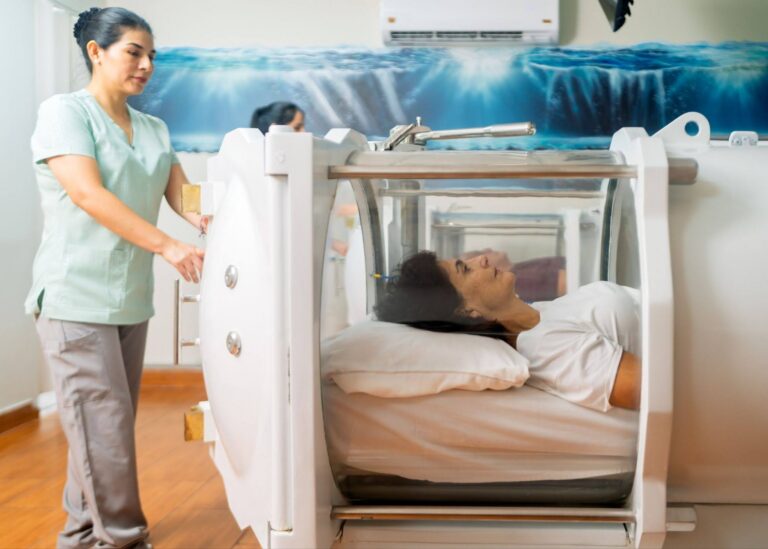
Hyperbaric oxygen therapy involves breathing pure oxygen inside a pressurized chamber at 1.5 to 3 times normal atmospheric pressure.
How increased oxygen may help healing
When you breathe concentrated oxygen under increased pressure, more of it dissolves into the blood and reaches tissues throughout the body, including the brain.
HBOT has established clinical uses for conditions like decompression sickness, carbon monoxide poisoning, and certain wound types. Concussion and brain injury are not among its standard applications.
How HBOT May Support Concussion Recovery
While HBOT is not a standard treatment for concussions, some research suggests it may support the brain’s recovery in several ways.
Potential ways HBOT may help after a concussion
- Oxygen delivery to injured brain tissue. After a concussion, blood flow to certain brain areas may drop. HBOT could help by increasing dissolved oxygen, reaching areas with reduced supply.
- Reducing inflammation. Swelling around injured brain cells can slow recovery. Some animal studies suggest higher oxygen levels may reduce inflammation, though human data remains inconsistent.
- Supporting new blood vessel growth. HBOT may encourage new blood vessel growth (angiogenesis), potentially improving blood flow to damaged areas over time.
- Promoting neuroplasticity. Neuroplasticity is the brain’s ability to form new connections after an injury. Some researchers believe HBOT may support this process, though more evidence is needed.
What the Research Says So Far
The evidence on HBOT for concussions is mixed. Some studies show promising results, while others show no clear benefit over placebo.
Studies showing possible benefits
A 2013 randomized, crossover controlled trial published in PLoS One studied 56 people with post-concussion syndrome lasting 1 to 5 years. Participants received 40 sessions at 1.5 ATA, and researchers reported improvements in cognitive function and quality of life. However, the control arm was a no-treatment period rather than a sham chamber, making it harder to isolate the effect of the oxygen itself (Boussi-Gross et al., PLoS One).
A 2022 study in Scientific Reports found that HBOT may improve cognitive and behavioral function in children with persistent post-concussion syndrome, with gains in memory, executive function, and emotional regulation (Hadanny et al., Scientific Reports).
Studies showing limited or no benefit
A sham-controlled trial involving U.S. military service members with persistent post-concussion symptoms found that HBOT at 1.5 ATA did not produce better outcomes than sham treatment at 1.2 ATA. Both groups improved, suggesting possible placebo effects (Cifu et al., JAMA Internal Medicine).
A 2012 Cochrane review by Bennett et al. examined the evidence for HBOT in traumatic brain injury and concluded the available data did not support routine clinical use (Bennett et al., Cochrane Database of Systematic Reviews).
What this means for you
HBOT may hold promise as a supportive therapy, but no major medical body currently recommends it as standard care for concussions. The VA/DoD clinical practice guideline for mild TBI does not currently recommend HBOT, though some clinicians still offer it within a broader care plan.
For those who choose to explore HBOT, knowing what treatment involves can help set realistic expectations.
What HBOT Treatment Generally Looks Like
A typical HBOT course involves 20 to 40 sessions, each lasting 60 to 90 minutes inside a pressurized chamber. Sessions are usually scheduled several times per week, and most people return to usual activities right afterward. Some experience mild fatigue or slight ear pressure, similar to the feeling during a plane’s descent.
At Rocky Mountain Regenerative Medicine in Boulder, Colorado, HBOT is offered as part of a personalized regenerative care model. The clinical team evaluates each patient before recommending a protocol that may combine HBOT with other therapies. For more on how HBOT fits into a broader plan, see RMRM’s guide to the benefits of hyperbaric oxygen therapy.
Who May Consider HBOT After a Concussion
HBOT is not right for everyone, and because the research is still evolving, most providers recommend it only in specific situations.
Athletes and sports-related concussions
Athletes in contact sports like football, hockey, soccer, and cycling face higher concussion risk. For those with lingering cognitive symptoms that rest protocols haven’t resolved, HBOT may be worth discussing with a regenerative medicine provider. Some patients report improvements in mental clarity and focus, though results vary.
Other candidates
Beyond athletes, HBOT might be worth considering for anyone who:
- Has experienced concussion symptoms for several months despite standard care
- Struggles with cognitive symptoms like brain fog or difficulty concentrating
- Has not improved with other approaches like vestibular therapy or graded exercise
- Has been evaluated by a provider who has ruled out other causes
HBOT should never replace emergency care for a new head injury. Danger signs like repeated vomiting, slurred speech, worsening headache, seizures, or loss of consciousness require immediate medical attention.
Possible Side Effects and Safety
Hyperbaric oxygen therapy is generally safe when administered by trained professionals, though side effects can occur.
Common side effects
- Ear or sinus discomfort from pressure changes (similar to air travel)
- Mild fatigue after sessions
- Temporary changes in vision
Rare side effects
- Middle ear injury (barotrauma)
- Oxygen toxicity (very rare at pressures used for concussion protocols)
- Seizures (extremely uncommon)
A provider should evaluate each person before starting HBOT. People with certain lung conditions, ear problems, or other medical concerns may need to avoid it.
A Note on Insurance
Most insurance plans do not cover HBOT for concussion because it remains investigational. Ask your provider about costs and session packages.
Taking the Next Step Toward Recovery
Research continues to clarify how HBOT may fit into concussion recovery.
At Rocky Mountain Regenerative Medicine (RMRM) in Boulder, the approach to post-concussion care goes beyond any single therapy. RMRM offers hyperbaric oxygen therapy alongside options like stem cell therapy, peptide therapy, and hormone optimization, tailored to each patient through the Annual Membership Program.
If you’re dealing with lingering concussion symptoms, contact RMRM or book an appointment to start a conversation about what recovery could look like for you.
Disclaimer: The information in this article is for educational purposes only and is not intended as medical advice. Hyperbaric oxygen therapy for concussion is considered investigational and is not a standard treatment for brain injury. Always consult a qualified healthcare professional before considering any treatment.
Sources:
- CDC: TBI Data and Research
- Boussi-Gross et al. (2013), PLoS One
- Hadanny et al. (2022), Scientific Reports
- Cifu et al. (2013), JAMA Internal Medicine (HOPPS Trial)
- Bennett et al. (2012), Cochrane Database of Systematic Reviews