
You have been putting in the work, training consistently, eating well, and prioritizing sleep. And yet something has shifted. Recovery takes longer. Body composition changes feel harder to come by. Maybe you have started reading about peptides online and found yourself sorting through conflicting information that never quite answers the question you actually care about: is any of this safe, and how do I do it the right way?
That frustration is valid. Natural growth hormone production tends to decline with age, potentially by 14% per decade after age 30, according to a review in Clinical Interventions in Aging. Certain peptides may help signal your body to produce more of its own GH. But where those peptides come from, and whether anyone is monitoring your response, makes all the difference. For anyone in Boulder, CO, or the Front Range considering peptides for muscle-related goals, understanding that clinical difference matters first.
Key Takeaways
- Peptides are short amino acid chains that may support the body’s natural growth hormone production and recovery.
- Clinical peptide therapy involves a provider recommendation, lab work, pharmaceutical-grade compounds, and ongoing medical oversight.
- Research peptides sold online are unregulated and may contain unknown impurities.
- A doctor monitors peptide therapy through baseline and follow-up lab panels, including IGF-1 and metabolic markers.
- Peptides do not replace training, nutrition, or sleep. At best, they may amplify a foundation already in place.
Table of Contents
- Research Peptides vs. Clinical Peptide Therapy: What Is the Difference?
- Why Medical Supervision Changes the Risk Profile
- What a Clinical Peptide Protocol Looks Like at RMRM
- Which Peptides Are Used for Muscle Growth and Recovery in a Clinical Setting?
- Is Clinical Peptide Therapy Right for You?
- Conclusion
- Frequently Asked Questions
Research Peptides vs. Clinical Peptide Therapy: What Is the Difference?
Many people first hear about peptides through online forums, biohacking communities, or fitness influencers, where “research peptides” are easy to find and easy to buy. However, the gap between those products and what you receive through physician-supervised peptide therapy is significant. Understanding peptide therapy and research peptides is the first step toward a safer decision.
What Are Research Peptides and Why Are They Risky?
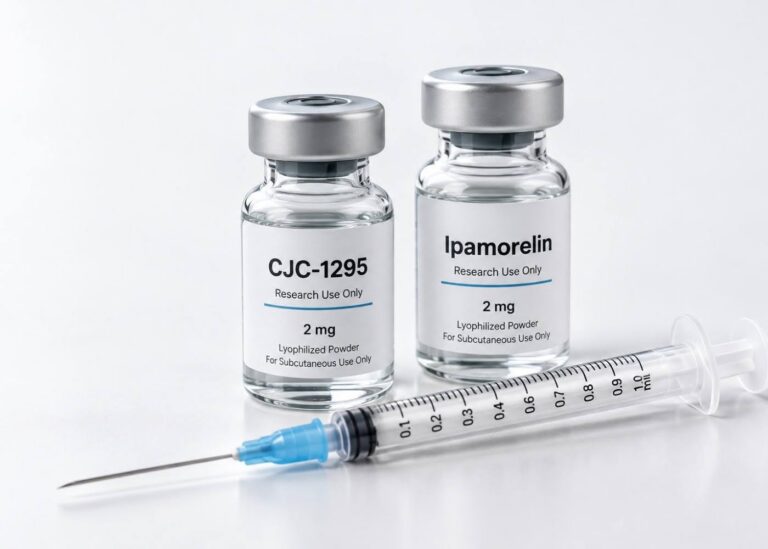
“Research peptides” are products sold online, often labeled “for research use only” or “not for human consumption.” Despite those labels, many people purchase and self-administer them, and the problems with that approach are real:
- Unknown purity. Without third-party testing from a registered manufacturer, there is no guarantee of what is in the vial. Contaminants, degraded compounds, and incorrect concentrations are all documented concerns.
- No medical evaluation. Self-administering peptides without lab work means you have no way of knowing whether your body is a good candidate, or whether an underlying condition could create a safety issue.
- No dosing guidance. Online protocols vary widely and are typically based on anecdotal reports rather than clinical evidence.
The FDA has noted that peptides labeled “research use only” are not authorized for human administration. In July 2026, the FDA’s Pharmacy Compounding Advisory Committee began reviewing several popular peptides for potential inclusion on the compounding bulks list, a process that could expand access to pharmaceutical-grade compounds through licensed providers.
What Does Clinical Peptide Therapy Actually Include?
Physician-supervised peptide therapy starts with a completely different process. A licensed provider evaluates your health history, orders baseline labs, and determines whether a peptide protocol makes sense for your specific situation. The peptides come from licensed compounding pharmacies that meet established purity standards, and in the United States, most therapeutic peptides require a prescription. A clinical framework provides accountability at every step, while an online purchase offers none.
Why Medical Supervision Changes the Risk Profile
Monitoring is what separates a clinical protocol from guesswork. Your body’s response to any peptide depends on your hormonal baseline and metabolic health, so a provider who tracks these markers can catch problems early.
What Labs Are Checked Before and During a Peptide Protocol?
Before starting, a responsible provider will typically order:
- IGF-1 levels: a key marker of growth hormone activity that establishes your starting point
- Fasting glucose and metabolic panel: because GH can affect insulin sensitivity, metabolic health needs to be assessed upfront
- Hormone panel: testosterone, thyroid, and other hormones that interact with GH signaling
- Inflammatory markers: to identify underlying conditions that could affect response
Follow-up labs are usually repeated at the 6-to-8-week mark. If IGF-1 has not risen as expected, or if metabolic markers shift in an unwanted direction, the provider adjusts the protocol. A practice that offers comprehensive diagnostics can integrate peptide monitoring into a broader health picture.
A placebo-controlled trial in The Journal of Clinical Endocrinology and Metabolism found that CJC-1295 produced dose-dependent increases in GH and IGF-1 in healthy adults after a single injection. Without lab monitoring, you would have no way of knowing whether your body is responding similarly.
What a Clinical Peptide Protocol Looks Like at RMRM
Reading about peptides online gives you general information, but working with a clinical team gives you a protocol built around your actual physiology. At Rocky Mountain Regenerative Medicine, peptide therapy follows a structured, data-driven process.
How Does the RMRM Process Work?
Step 1: Consultation and health intake. Every protocol begins with a thorough evaluation. Your provider reviews your health history, current medications, training background, and goals.
Step 2: Biomarker testing and baseline labs. Before any peptide is prescribed, comprehensive blood work establishes your hormonal, metabolic, and inflammatory baseline. IGF-1, fasting glucose, hormone levels, and other relevant markers guide which peptides, if any, make sense for your situation. The clinic’s diagnostic capabilities allow this testing to happen in-house.
Step 3: Personalized protocol and ongoing reassessment. Based on your lab results and goals, your provider prescribes a tailored protocol with specific compounds, dosing, and administration instructions. Follow-up labs at the 6-to-8-week mark confirm the expected response. If adjustments are needed, your provider makes them based on data rather than guesswork.
For patients whose goals extend beyond peptides alone, protocols can be layered with hormone optimization, IV therapy, or other modalities through the clinic’s annual membership program.
Which Peptides Are Used for Muscle Growth and Recovery in a Clinical Setting?
Peptides used in clinical practice for muscle growth generally fall into two categories: growth hormone secretagogues and recovery-focused compounds. A full breakdown of individual peptides and what the research shows is available in our guide to muscle growth peptides. What follows is a brief overview of each category.
What Are the Main Categories?
Growth hormone secretagogues are the most commonly prescribed peptides for body composition goals. Sermorelin, a synthetic version of growth hormone-releasing hormone, has been described in Clinical Interventions in Aging as a potentially favorable alternative to direct GH replacement because it preserves the body’s natural feedback mechanisms. CJC-1295 paired with Ipamorelin is another common combination, and Ipamorelin in particular tends to release GH without significantly elevating cortisol or prolactin.
Recovery-focused peptides may support muscle growth indirectly by helping you recover faster and train more consistently. BPC-157 is a synthetic peptide with promising preclinical data on tissue repair, and clinical interest continues to grow as researchers work to expand the human evidence base. GHK-Cu, a naturally occurring copper peptide involved in collagen production, is another compound drawing clinical interest as its plasma levels tend to decline with age.
For a deeper look at each compound, see our complete peptide guide.
Is Clinical Peptide Therapy Right for You?
Peptides are not steroids, and they are not a shortcut. A two-year randomized trial in 65 healthy adults aged 60 to 81 found that fat-free mass increased compared to placebo with an oral growth hormone secretagogue. The changes were gradual rather than dramatic, which is typical of compounds that work with the body’s own hormonal rhythm.
What Should You Realistically Expect?
Patients have experienced improvements in sleep quality and recovery speed within the first few weeks, with measurable body composition changes developing over 3 to 6 months. Peptides may amplify the signal your training provides, but they do not create it.
Clinical peptide therapy for muscle growth tends to be most relevant if:
- You are over 35 and noticing slower recovery, shifting body composition, or less restorative sleep despite consistent training.
- Your lab work shows declining IGF-1 or suboptimal growth hormone markers.
- You have a chronic injury history that limits training consistency.
For younger adults with normal hormone levels and room for improvement in training or nutrition, the basics will almost always deliver more value than peptides.
Conclusion
The difference between physician-supervised peptide therapy and self-directed use of research chemicals comes down to safety, purity, dosing accuracy, and ongoing lab monitoring. When peptides are managed within a clinical framework, they may become a meaningful part of a broader approach to muscle growth, recovery, and long-term health.
Ready to find out whether clinical peptide therapy may support your goals? Contact Rocky Mountain Regenerative Medicine to learn more, or book an appointment to start with a consultation and baseline lab work.
Note: This content is for educational and informational purposes only. Nothing in this article is intended as medical advice, diagnosis, or a recommendation for any specific treatment. Peptide therapy involves prescription compounds and requires evaluation by a licensed healthcare provider. Individual results vary. Please consult a qualified medical professional before beginning any new health protocol.
Sources
- Walker RF. “Sermorelin: a better approach to management of adult-onset growth hormone insufficiency?” Clinical Interventions in Aging. 2006;1(4):307-308. https://pmc.ncbi.nlm.nih.gov/articles/PMC2699646/
- Teichman SL, Neale A, Lawrence B, et al. “Prolonged stimulation of growth hormone (GH) and insulin-like growth factor I secretion by CJC-1295, a long-acting analog of GH-releasing hormone, in healthy adults.” The Journal of Clinical Endocrinology and Metabolism. 2006;91(3):799-805. https://pubmed.ncbi.nlm.nih.gov/16352683/
- Nass R, Pezzoli SS, Oliveri MC, et al. “Effects of an oral ghrelin mimetic on body composition and clinical outcomes in healthy older adults: a randomized trial.” Annals of Internal Medicine. 2008;149(9):601-611. https://pubmed.ncbi.nlm.nih.gov/19174493/
- Sinha DK, Balasubramanian A, Tatem AJ, et al. “Beyond the androgen receptor: the role of growth hormone secretagogues in the modern management of body composition in hypogonadal males.” Translational Andrology and Urology. 2020;9(Suppl 2):S149-S159. https://pmc.ncbi.nlm.nih.gov/articles/PMC7108996/
- Józwiak M, Bauer M, Kamysz W, Kleczkowska P. “Multifunctionality and Possible Medical Application of the BPC 157 Peptide, Literature and Patent Review.” Pharmaceuticals. 2025;18(2):185. https://pmc.ncbi.nlm.nih.gov/articles/PMC11859134/
- U.S. Food and Drug Administration. “July 23-24, 2026: Meeting of the Pharmacy Compounding Advisory Committee.” https://www.fda.gov/advisory-committees/advisory-committee-calendar/july-23-24-2026-meeting-pharmacy-compounding-advisory-committee-07232026