
You are doing the work. You are training consistently, eating well, and prioritizing sleep. But recovery takes longer than it should, sleep feels shallow, and the energy you used to count on just is not there anymore.
If that sounds familiar, you are not alone. Many active adults in their 30s, 40s, and beyond hit a point where effort alone stops delivering results. Often, what is quietly shifting is your body’s natural growth hormone output, which tends to decline gradually with each passing decade.
CJC-1295 ipamorelin peptide therapy is one approach gaining attention across regenerative medicine clinics, from the Colorado Front Range to practices nationwide. Here is what the current evidence shows.
Key Takeaways
- CJC-1295 is a synthetic analog of GHRH that may extend the natural growth hormone signal in your body.
- Ipamorelin is a growth hormone-releasing peptide that may trigger a targeted GH pulse without significantly raising cortisol or prolactin.
- The two peptides work on different receptor systems, which is why clinicians often combine them.
- Neither peptide is currently available as a commercially marketed medication, and the regulatory landscape continues to evolve.
- Potential benefits may include improved sleep, body composition changes, and faster recovery, but large-scale human trials are limited.
- A qualified medical provider should always supervise any peptide therapy protocol.
Table of Content
- Key Takeaways
- What Is CJC-1295 and How Does It Work?
- What Is Ipamorelin and What Makes It Different?
- What to Expect: Dosing, Timeline, and Administration
- Potential Benefits Patients Have Experienced
- Side Effects and Safety Considerations
- How the Stack Compares to Other Approaches
- Is This Peptide Stack Right for You?
- Why Medical Supervision Matters
- Frequently Asked Questions
What Is CJC-1295 and How Does It Work?
Your brain naturally produces growth hormone releasing hormone (GHRH), which tells your pituitary gland to make and release growth hormone. The challenge is that natural GHRH breaks down very quickly in the body, often within minutes, which limits how long its signal lasts.
CJC-1295 is a lab-made version of GHRH designed to stay active much longer. A 2006 study in the Journal of Clinical Endocrinology and Metabolism found that a single injection produced dose-dependent increases in growth hormone lasting six or more days in healthy adults, with IGF-1 levels rising 1.5- to 3-fold above baseline.
The peptide comes in two forms. One includes a “Drug Affinity Complex” (DAC) that extends its active life to roughly six to eight days, while the other version (modified GRF 1-29) has a shorter active life and produces a quicker burst. Animal research has supported the long-acting nature of CJC-1295, showing that once-daily dosing maintained normal growth and body composition in GH-deficient models. Most clinical protocols use the no-DAC form when stacking with ipamorelin, because its shorter action creates a controlled pulse that pairs more cleanly with ipamorelin’s short-acting mechanism.
What is CJC-1295 used for?
Clinicians have explored CJC-1295 for supporting body composition, sleep quality, post-exercise recovery, and tissue repair. Most of the current evidence comes from early-phase studies, clinical observations, and the broader growth hormone literature rather than large-scale dedicated trials on this specific peptide.
What Is Ipamorelin and What Makes It Different?
While CJC-1295 mimics the body’s GHRH signal, ipamorelin works through a separate pathway by mimicking a hormone called ghrelin. When ipamorelin activates the ghrelin receptor (GHS-R1a) on the pituitary gland, the result is an immediate pulse of growth hormone release.
What makes ipamorelin stand out is its selectivity. A foundational study in the European Journal of Endocrinology found that ipamorelin stimulated growth hormone release without significantly raising cortisol or ACTH levels, even at very high doses. Older GH-releasing compounds were known for appetite spikes and cortisol elevation, but ipamorelin appears to avoid most of those issues.
CJC-1295 vs. ipamorelin: what is the difference?
The key difference comes down to the receptor each peptide targets.
- CJC-1295 binds to the GHRH receptor, increasing baseline growth hormone production over an extended period.
- Ipamorelin binds to the ghrelin receptor (GHS-R1a), triggering a stronger but shorter pulse of growth hormone release.
When combined, the two peptides work together so that one increases production while the other triggers release. Because each activates a completely different signaling pathway on the same pituitary cells, the resulting growth hormone pulse may be significantly larger than either peptide alone. No published human trial has directly tested the combination against each peptide individually, so the synergy is supported by receptor pharmacology rather than a dedicated clinical study. Your pituitary gland still regulates the output, which may reduce the risk of excess growth hormone levels.
What to Expect: Dosing, Timeline, and Administration
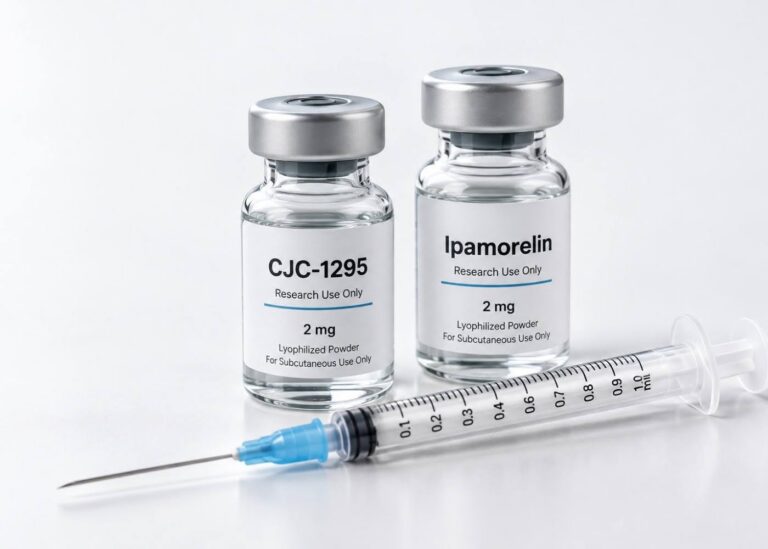
Protocols vary by provider, but most follow a similar general structure. Both peptides are delivered as subcutaneous injections using a small insulin-style needle and come in a freeze-dried powder form that gets mixed with bacteriostatic water before use. Most providers prescribe nightly administration before bed, because growth hormone naturally surges during deep sleep. Doses generally fall in the range of 100 to 300 mcg per peptide, though the exact amount depends on body weight, lab results, and your provider’s judgment.
What does the typical timeline look like?
Results are not immediate, and individual experiences vary. That said, patients have generally noticed changes along a timeline that looks roughly like this:
- Weeks 1 to 2: Improved sleep quality is often the first noticeable change.
- Weeks 3 to 4: Gradual improvements in energy and post-exercise recovery.
- Weeks 6 to 12: More noticeable body composition shifts, including changes in body fat and lean muscle.
Many clinical protocols run for three to six months, followed by a break period to allow the pituitary to reset.
Potential Benefits Patients Have Experienced
The CJC-1295 and ipamorelin combination has been connected to several potential benefits. Here is a closer look at the most commonly reported outcomes and what the evidence can and cannot confirm.
May sleep quality improve?
Sleep is often the first change patients notice, which makes sense given that growth hormone naturally peaks during deep sleep. Amplifying that signal before bedtime could enhance the nocturnal surge, and some patients have reported feeling more rested within one to two weeks. That said, controlled studies linking this specific peptide stack to sleep improvements in healthy adults are limited.
Could body composition change?
Growth hormone plays a role in fat breakdown and protein synthesis, and some patients have noticed gradual shifts in body fat and lean muscle over several months. Any meaningful change, however, depends heavily on diet, exercise, and overall lifestyle.
Does recovery speed up?
Elevated growth hormone and IGF-1 levels may support tissue repair in muscles, tendons, and connective tissue. Peptide therapy for recovery is one of the more common reasons patients explore this stack, and many report shorter downtime between workouts, though rigorous trial data on the specific combination remains limited.
What about skin and hair?
Growth hormone may support collagen production, which plays a role in skin elasticity, hair thickness, and nail strength. Some patients have noticed improvements over three to six months, though evidence for cosmetic benefits remains largely anecdotal at this point.
Side Effects and Safety Considerations
Is CJC-1295 safe?
The available evidence suggests that CJC-1295 is generally well tolerated at moderate doses. A review of growth hormone secretagogue safety noted that these compounds promote pulsatile GH release while preserving the body’s natural feedback mechanisms, and the 2006 Teichman study reported no serious adverse events at doses of 30 or 60 micrograms per kilogram, though that study was small and short-term. Common side effects patients may experience include:
- Mild redness or irritation at the injection site
- Temporary water retention in the first few weeks
- Occasional headaches, especially early in use
- Tingling or numbness in the hands or fingers
- Mild nausea or changes in appetite
Because growth hormone influences blood sugar regulation, the stack could also affect insulin sensitivity over time, so patients with prediabetes or diabetes should discuss this with a provider before starting.
Regulatory status matters
CJC-1295 and ipamorelin are not currently available as commercially marketed medications. The Pharmacy Compounding Advisory Committee reviewed both substances in late 2024 and recommended against including them in the 503A Bulks Regulation. The regulatory landscape continues to evolve, and any peptide protocol should only be pursued under the supervision of a licensed medical provider.
How the Stack Compares to Other Approaches
Direct HGH injections deliver synthetic growth hormone at a fixed dose, but HGH can suppress your body’s own production and may cause joint pain, insulin resistance, and edema. HGH therapy also costs significantly more, generally $800 to $2,000 or more per month, compared to peptide stack protocols in the $200 to $500 range.
Sermorelin is a gentler GHRH analog with a shorter half-life that some providers use as a starting point. Lifestyle interventions, including resistance training, adequate protein, quality sleep, and hormone optimization, remain the most evidence-backed approach. For many patients, the CJC-1295 and ipamorelin stack occupies a middle ground: potentially more targeted than lifestyle changes alone, but with fewer risks than direct HGH replacement.
Is This Peptide Stack Right for You?
Not every patient is a candidate for growth hormone releasing peptides. Those who may benefit most generally share a few characteristics:
- Active adults who notice that post-exercise soreness or joint stiffness takes longer to resolve than it used to
- Patients experiencing poor sleep quality that has not responded to lifestyle changes alone
- Adults with body composition goals who are already consistent with resistance training and nutrition
- People interested in a broader peptide and regenerative approach as part of a long-term longevity strategy
On the other hand, patients with active cancer, uncontrolled diabetes, pituitary disorders, or who are pregnant or breastfeeding should not pursue this stack. Only a thorough evaluation by a licensed provider can determine candidacy.
Why Medical Supervision Matters
Peptides are not supplements you can safely self-prescribe. CJC-1295 and ipamorelin should only be used under the supervision of a licensed provider and sourced through a regulated compounding pharmacy when available. Because the regulatory landscape continues to evolve, the prescribing and compounding pathway may differ depending on your state and provider.
A qualified provider will order baseline bloodwork, including IGF-1, metabolic markers, and hormonal levels, before prescribing and then track your response with follow-up labs at regular intervals.
Self-sourcing peptides online bypasses these safeguards entirely. Products sold outside of regulated pharmacies carry risks of unknown purity, incorrect concentrations, and contamination. For a broader look at how growth hormone releasing peptides fit into regenerative medicine, our related guide covers additional options worth discussing with a provider.
Conclusion
CJC-1295 and ipamorelin represent one approach to growth hormone support that works with your body’s own signaling systems rather than replacing them. The evidence is still early, but for individuals working under medical supervision, the stack may offer a more targeted option compared to direct HGH therapy.
At Rocky Mountain Regenerative Medicine in Boulder, Colorado, our team takes a personalized approach to peptide therapy, hormone optimization, and longevity. Through comprehensive diagnostics and ongoing monitoring via our Annual Membership Program, we help you make informed decisions about your health.
Contact us to start a conversation or book an appointment today.
Medical Disclaimer: The information in this article is for educational purposes only and is not intended as medical advice. CJC-1295 and ipamorelin are not commercially marketed medications. Consult with a qualified healthcare professional before considering any peptide therapy or treatment protocol. Results vary by individual.
Sources
- Teichman SL, Neale A, Lawrence B, Gagnon C, Castaigne JP, Frohman LA. Prolonged stimulation of growth hormone (GH) and insulin-like growth factor I secretion by CJC-1295, a long-acting analog of GH-releasing hormone, in healthy adults. J Clin Endocrinol Metab. 2006;91(3):799-805. https://pubmed.ncbi.nlm.nih.gov/16352683/
- Raun K, Hansen BS, Johansen NL, et al. Ipamorelin, the first selective growth hormone secretagogue. Eur J Endocrinol. 1998;139(5):552-561. https://pubmed.ncbi.nlm.nih.gov/9849822/
- Sigalos JT, Pastuszak AW. The safety and efficacy of growth hormone secretagogues. Sex Med Rev. 2018;6(1):45-53. https://pubmed.ncbi.nlm.nih.gov/28400207/
- U.S. Food and Drug Administration. Pharmacy Compounding Advisory Committee (PCAC). https://www.fda.gov/advisory-committees/human-drug-advisory-committees/pharmacy-compounding-advisory-committee
- Alba M, et al. Once-daily administration of CJC-1295, a long-acting GHRH analog, normalizes growth in the GHRH knockout mouse. Am J Physiol Endocrinol Metab. 2006;291(6):E1298-1304. https://pubmed.ncbi.nlm.nih.gov/16822960/